
No. As explained in Starstruck Tonight:
A slow wobble in the Earth's daily rotation causes the Earth's north pole to trace a circle among the stars every 26,000 years. Because of this motion, called precession, the star nearest the pole is not always the same. Architects of the great Egyptian pyramid used Thuban (TOO-bahn), a star in the constellation Draco the Dragon, for their north star (they aligned an open shaft in its direction; and pointed another air shaft toward Orion).
Polaris, the tip of the Little Dipper's handle, currently lies within three-quarters of a degree from the polar point, and will reach its closest proximity--under half a degree--in the year 2102 AD. No matter where you are in the northern hemisphere, when you face Polaris you are facing north. Polaris now points northward more accurately than a magnetic compass.
In 14,000 years Vega will become the pole star. This extremely slow but steady cycle of precession was discovered around 150 B.C by the ancient astronomer Hipparchos. Hipparchos combined the qualitative geometrical systems of the Greeks with the quantitative astronomy of the Babylonians, whose ancient observations were etched on cuneiform tablets. This remarkable fusion of cultures, embodied in the achievements of Hipparchos, greatly benefited Ptolemy 300 years later.
Ptolemy advised his readers that to comprehend the great cycles of the stars provides serenity in the midst of continually changing earthly life:
Above all things, astronomy can make men see clearly. From the constancy, order, symmetry and calm which are associated with the divine, astronomy makes its followers lovers of this divine beauty, accustoming them and reforming their natures, as it were, to a similar spiritual state.
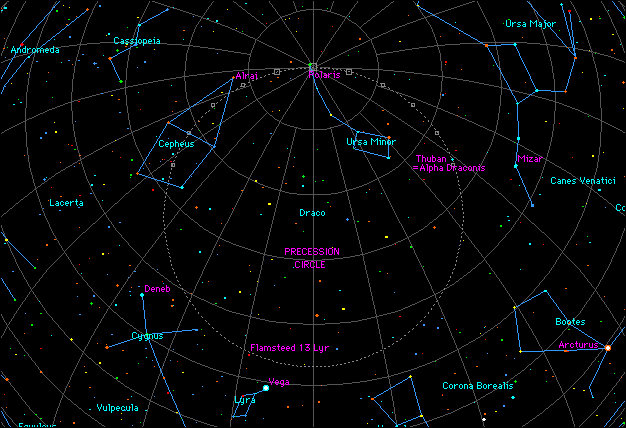
 Star chart created with Voyager II Software for Macintosh,
published by Carina Software. This is just a taste of what Voyager
can do! For info on Voyager II software, call Carina Software at
(510) 355-1266, write them at 12919 Alcosta Blvd Suite #7, San Ramon,
CA 94583, or visit Carina
Software's home page and check out Voyager II for yourself.
25,780 years or, as explained in the Starstruck Tonight script above, approximately 26,000 years.
Now lying less than 1 degree from true north, Polaris will reach its nearest approach to true north around 2110.
Thuban (TOO-ban) in Draco the Dragon. Thuban was a very accurate indicator of true north, but it is not as bright as Polaris.