
| Other names: | Dolostone |
| Mineral class: | Carbonate |
| Composition: | Calcium magnesium carbonate, CaMg(CO3)2 |
| Hardness: | 3.5 - 4 |
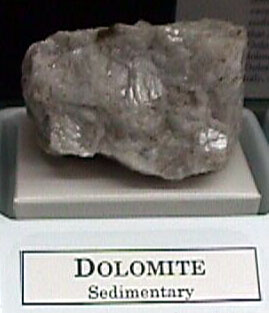
| Luster: | Pearly, Vitreous |
| Color: | Colorless, Pink, White, Yellow |
| Streak: | White to pale grey |
| Cleavage: | Perfect in 3 directions, not at right angles |
| Specific Gravity: | 2.85-2.95 |
| Crystal form: | Hexagonal Rhombohedral. Crystal faces are usually curved. |
| Environment: | Dolomite is a common constituent of sedimentary carbonate rocks (dolomitic limestones or dolostones). Dolomite also occurs in hydrothermal veins and in metamorphic rocks such as dolomitic marbles. |
| Uses: | Building; metallurgy; chemical industries. Dolomitic rocks often are reservoir rocks for petroleum. |
| Comments: |
 |