
| Other names: |
|
| Mineral class: | Sulfate |
| Composition: | CaSO4 2H2O |
| Hardness: | 1 - 2.5 |
| Luster: |
|
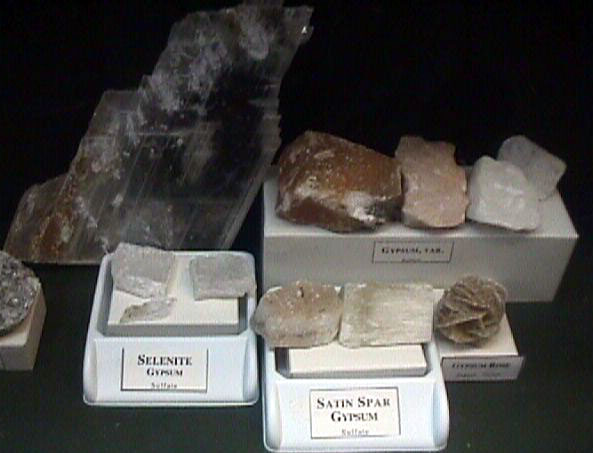
| Color: | Mostly white to light gray; iron oxide can add red tints. Selenite is tranparent. With impurities it can be translusent, white, gray, yellow, red, etc. |
| Streak: | White |
| Cleavage: | Selenite has perfect cleavage in 1 plane; good cleavage in 2 other planes. |
| Crystal form: |
|
| Environment: | Chemical formation by arid climate evaporation of saline lakes or sea water, in restricted or cut-off bays. For an interesting account, read chapter 1 of Kenneth Hsu, The Mediterranean was a Desert. |
| Uses: | Plaster of Paris, fertilizer, Portland cement, wallboard, and other building materials |
| Comments: | May be scratched by fingernail. When the water of hydration is absent, calcium sulfate occurs as the harder, heavier mineral Anhydrite.
 |