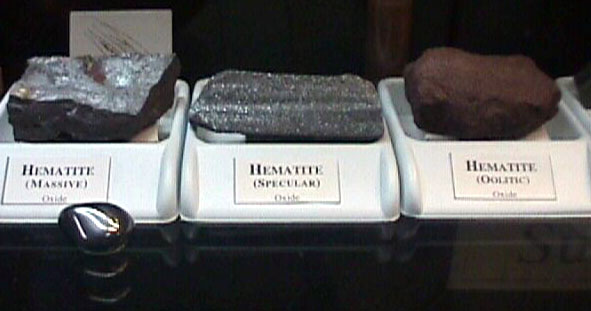
| Other names: | - Massive Hematite resembles Magnetite in appearance and hardness, but may be distinguished by its reddish streak and absence of magnetism. It is beautiful when tumbled or polished.
- Oolitic Hematite is reddish in color and has a reddish streak. When moistened it provides a red ochre pigment. Oolitic hematite is named for its typical "oolitic" texture, which appears like tiny eggs, but are actually of chemical rather than organic origin. (Compare the "oolitic limestone" formation in England where the same texture is produced by chemical means.) Oolitic hematite is not magnetic.
- Specular Hematite resembles mica schist in its sparkly appearance. Its streak may be reddish, brown, or black. Sometimes it attracts a magnet.
|
| Mineral class: | Oxides and Hydroxides |
| Composition: | Iron Oxide, Fe2O3 |
| Hardness: | 5.5 - 6.5 |
| Luster: | Metallic to earthy to dull |
| Color: | Dark grey or steel grey, dark reddish-brown, black |
| Streak: | Reddish brown to black |
| Specific Gravity: | 4.9 - 5.3 |
| Crystal form: | Granular masses. Hexagonal |
| Uses: | Iron ore, jewelry |
| Comments: | The name comes from a Greek word meaning "bloodlike." Hematite is a common cementing material in red sandstones.
 |
