


 |
 |
|
4. The Fallacy of Rational Reconstruction, or the "Whig Interpretation of History"
| Previous page | Stonehenge index | Next page |
In his famous book, Stonehenge Decoded, Gerald Hawkins claimed that the circle of Aubrey holes were used to predict lunar eclipses. The astronomer Fred Hoyle came up with a different method by which he could use these structures to predict eclipses as well. But the exercises of Hawkins and Hoyle are largely beside the point, because we have little evidence that the structures were actually used by the builders of Stonehenge in that way. Such rational reconstruction is not history.
Hawkins, Hoyle and a host of other writers on Stonehenge have clearly fallen prey to "rational reconstruction," or writing history backwards. Their enthusiasm for their own present-day knowledge has clouded their historical sensibility. Yet there is a fallacy in this kind of reasoning: "Modern astronomer that I am, I can figure out a way to predict lunar eclipses using alignments I can find at Stonehenge. Therefore Stonehenge was built for the purpose of predicting lunar eclipses." Do you see the problem with this method?
 "Rational
reconstruction" is describing a journey by looking through the rear-view
mirror; interpreting everything in light of present knowledge, as if it were
inevitable that things would turn out the way they did. But before we journeyed
around the last bend in the road, we didn't actually know what the road would
hold in store.
Many people tend to think about history in the same way: we know they were at Point A; we are now at Point B. If the most logical way to go from Point A to Point B would have been to travel on Road C, then we tend to think that Road C was the way history unfolded. This is rational reconstruction: reconstructing how things should have happened based on the most rational series of steps leading up to our present knowledge.
But usually the history of science is a lot more interesting than that! Rational reconstruction removes the drama from history and saps the creativity from scientific discovery. We often find rational reconstruction in science textbooks, where caricatures of outmoded ideas and discoveries make it seem ridiculous that people could ever have failed to see what we now know to be the case. (In actuality, they probably held to a different set of beliefs that were far more complex than we suspect, yet within the framework of knowledge they took for granted, what they believed made very good sense.)
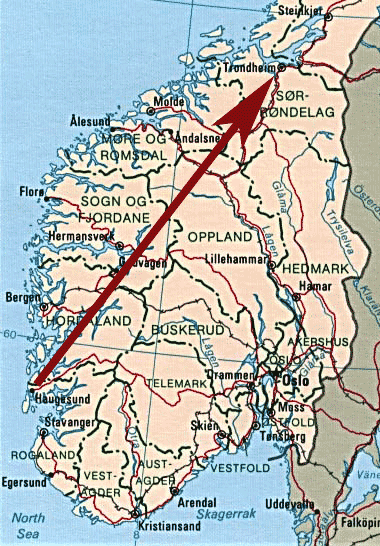
Consider this example. Suppose that we know in such and such a year (we can always look up the year, so we don't have to memorize it), an important figure for the history of science traveled from Haugesund to Trondheim in Norway. If we inspect the map at right, we might surmise that he took the most direct route to Trondheim. After all, we can take for granted that he got there, because "it's history," right?
If we surmise that our figure traveled in a straight line from Haugesund to Trondheim, that would be an exercise of rational reconstruction, not historical reconstruction. To the contrary, history is more often than not the story of the unexpected. Historical reconstruction results in a drama, rather than a predetermined conclusion. Historical reconstruction is based on actual evidence, not 20/20 hindsight (that is mainly guesswork). Rational reconstruction, as represented in the previous map, is quite different from the contingent events of history, as represented in the funny exercise below:
1. Go to MSN
Map & Directions
2. Under "Start," choose "Address in Norway"
3. Under "Start," choose "Haugesund" for City
4. Under "End," choose "Trondheim" for City (in Norway also)
5. Click "Get Directions"
As of January 2005, the route that MSN recommends (below) is definitely not a model of rational reconstruction! According to MSN, you can make the trip from Haugesund to Trondheim in under 48 hours (so long as you have a submersible!).
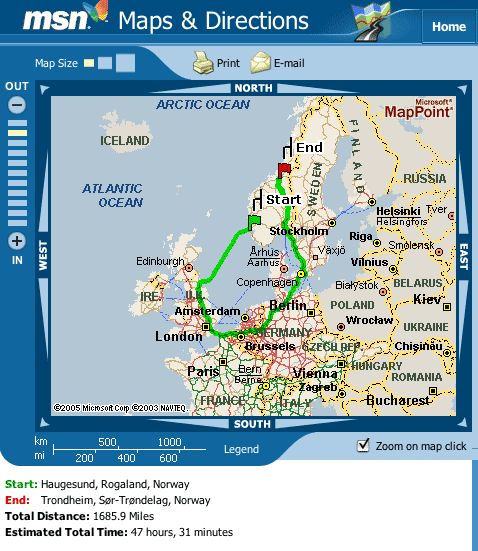 Oftentimes history is more like this MSN map than the one we created by rational
reconstruction. The pattern of a road map is a contingent thicket of crooked
and angled lines. To reconstruct how someone arrived in their later location,
study of a road-map like this will not suggest a single predictable or inevitable
route. Different folks may have arrived at Trondheim from a host of different
directions for a variety of unforeseen and contingent reasons.
Herbert Butterfield's classic little book, The Whig Interpretation of History (1931), has also given its name to the historiographical fallacy I'm calling rational reconstruction. Butterfield showed how political historians in the 19th Century wrote political history as if all past social orders had been groping along, trying but largely failing to achieve the Whig historians' own enlightened political views. If we substitute history of science for political history, the parallel is clear: Whig history of science would portray past cultures and scientists as blindly groping along, trying but largely failing to arrive at our own enlightened views. This kind of history is not only an obstacle to understanding, but it often becomes quite boring. If all that we can discover in others is that they were like ourselves, we will close our minds to a deeper understanding and miss the most important opportunities for interesting new discoveries.
So rational reconstruction, Whig history, or simply, "presentism," all mean "writing history backwards" -- evaluating the past in terms of present knowledge, seeing the past as so many steps on the way to us and our views. Rational reconstruction leads to precursor-itis; a preoccupation with discoveries and opinions that seem to anticipate our own, taken out of context and severed from the perspective of the persons who made them. This occurs when we hear someone say something like: "Stonehenge was the first astronomical observatory."
Beware of broad generalizations containing the word "first"! "First"
in what sense? And what is implied by an unqualified comparison between
Stonehenge and a modern astronomical observatory? Certainly, there were no telescopes
at Stonehenge! And who says Stonehenge was an observatory instead of a temple?
Who says it was designed for the use of coolly-rational scientists instead of
hot-blooded priests? Who says astronomy and priestcraft were incompatible at
that time, anyway? Rational reconstruction obscures so many interesting questions,
undermines our historical sensibility, and as often as not, even errs with respect
to the evidence (see next page).
| Previous page | Stonehenge index | Next page: Without evidence, history is speculation |
 The
classic discussion of "rational reconstruction" is Herbert Butterfield,
The Whig Interpretation of History (first published in 1931 and still
in print). An equally classic discussion of how this fallacy specifically relates
to the history of science is Stephen G. Brush, “Should the History of
Science be Rated X?” Science, 183 (1974): 1164-1172.
"Life can only be understood backwards, but it must be lived forwards." Soren Kierkegaard

|
HSCI 3013. History
of Science to 17th century |
spellcheck.net | wordcounter.net
Many thanks to the pedagogical model developed in Mythology and Folklore and other online courses by Laura Gibbs, which have been an inspiration for this course.
|
|
This course is currently undergoing major reconstruction to bring it into alignment with the new version of the course at Janux |
|||


