HOME - Janux - D2L - Email Wikipedia course web page Vimeo course videos Course materials at iTunes U (optional) Twitter: #ouhoscurator
History of Science Ancient Egypt

History of Science Online

- Course Info - Time tips - Semester at a glance - Weekly assignments at a glance - Timeline -

LibraryThing: Science in Ancient Mesopotamia Week 3: Ancient Egyptian and Aegean science

Starting Assumptions

# Due Date Pts Activity Time
1 Tuesday
11:59 p.m.
10 Starting Assumptions
Think about what you know already about the culture and period, share your knowledge and experience with other students in the class
30 min.

General description of the Starting Assumptions assignment.
Starting Assumptions Questions

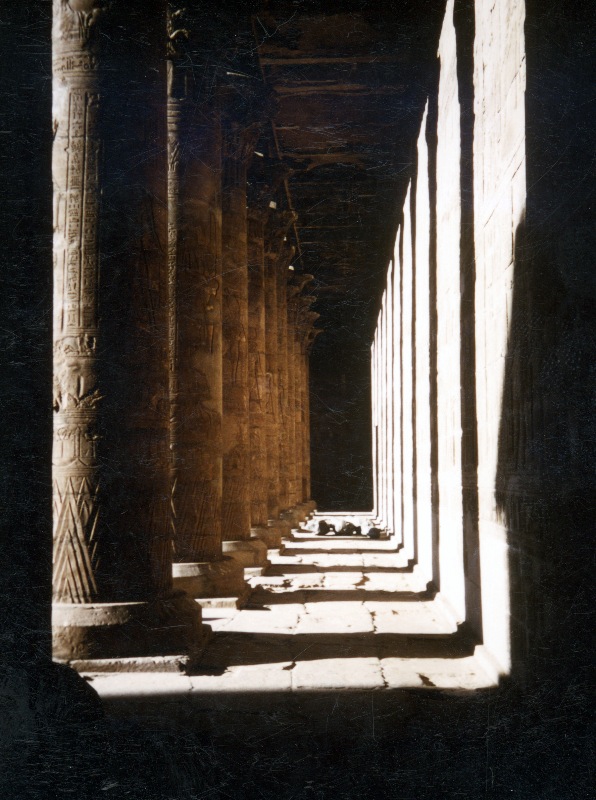
  1. Temple of Horus As a very young girl, my mother, Sue Magruder, found the book Lost Worlds by Anne Terry White (1941) in her local public library. She read it avidly, and was captivated. This story of the archaeological discoveries of modern times enthralled her, and instilled a life-long desire to visit Egypt, the land where time seems to stand still. A few years ago she finally realized her dream. At modern Edfu, she took the photograph of the colonnade of the Temple of Horus that provides the logo for this week (right, click for a larger view). The Temple of Horus actually belongs to the later Hellenistic period; it was begun in 237 BC and completed in 57 BC. When the Temple of Horus was constructed, the Egypt of the pyramids was already as ancient to them as the Temple of Horus is to us. Are you like my mother in having a life-long fascination with ancient Egypt, or with archaeology?
  2. What most interests you about...
    1. the history of ancient Egypt?
    2. Egyptian mythology?
    3. Great pyramid of Giza?
    4. Have you seen any great movies or documentaries on the history of Egypt, such as the Egypt episode of the History Channel series Engineering an Empire Engineering an Empire - Engineering an Empire - Egypt? (I highly recommend this video.)
  3. What most interests you about the history of Greece in the classical or Hellenic period? (Read this Wikipedia article from the beginning through the section on the Persian wars.)
  4. There are hundreds of movies and documentaries about ancient or Hellenic Greece. The History Channel, for example, has the Greece episode of Engineering an Empire Engineering an Empire - Engineering an Empire - Greece, and The Seven Wonders of the ancient World episode of Lost Worlds ( Lost Worlds - Lost Worlds, Season 2 - Seven Wonders of the World). Which movies or documentaries are your favorites, and why?
  5. Do you enjoy the literature, stories, or mythology of the ancient Egyptians or Greeks? If so, which ones, and why? (The Egyptian Book of the Dead? Homer's Iliad or Odyssey? Hesiod's Theogony or Works and Days? or "Behind the Mythology of Stargate SG-1" Stargate SG-1 - Stargate SG-1, Season 10 - Behind the Mythology of Stargate SG-1? etc.)
  6. Have you ever lived in or traveled to Egypt or Greece? If so, what did you see, and what kind of impression did it make on you?
  7. The Presocratic natural philosophers are often studied in introductory philosophy courses. Have you studied the Presocratic natural philosophers in a previous course? If so, was it in history or philosophy? What did you think of them? (If you haven't heard of them before, don't worry!) What are they doing in a history of science course? Why is it important to learn something about philosophy in order to study the history of science?
  8. ** What are some similarities between ancient Egyptian and Aegean cultures and culture today? How might these similarities help us to understand ancient Egyptian and Aegean cultures? What are some differences between ancient Egyptian and Aegean cultures and culture today? How might these differences pose an obstacle to our understanding of ancient Egyptian and Aegean cultures? What do you think is the chief barrier that obstructs modern appreciation of ancient Egyptian and Presocratic science?**


Instructions for Starting Assumptions assignment:

  1. Look over the questions and links below; then watch the Starting Assumptions video prompt for this unit at Janux.
  2. PART ONE:
    1. Write a paragraph, 150 words minimum, in response to any questions that interest you.
    2. Post your completed paragraph in the Starting Assumptions discussion stream for this week at Janux.
  3. PART TWO:
    • Read the Starting Assumptions posts of at least two other students at Janux. Make another post in the discussion stream at Janux replying to their posts. (If you are the first or second person to post, you will have to check back later to complete this part of the assignment.)
    • IMPORTANT: When you respond, please begin by greeting the persons by name you are replying to, so that they will be more likely to notice that you are replying to them. And over the next several hours, check back and see if anyone comments on your post as well. If you provide interesting comments in response to others, they will be more likely to look for your posts both now and in the future.
  4. As you post your paragraph and respond to two other students, complete the Gradebook Declaration in Desire2Learn. Your Gradebook Declaration is subject to the Honor Code. Check all that apply: if you have completed the assignment, you will check all five statements. If you work on the assignment at different times, you may make the Gradebook Declaration incrementally as you complete each part. You may redo the Gradebook Declaration as often as you like up until the due date, if any part is incomplete the first time.
 

Here is the text of the Desire2Learn Gradebook Declaration:

(2 points) I have posted my Starting Assumptions (at least 50 words) at Confluence, including a response to the required question(s).
(2 points) I have posted my Starting Assumptions (at least 100 words) at Confluence, including a response to the required question(s).
(2 points) I have posted my Starting Assumptions (at least 150 words) at Confluence, including a response to the required question(s).
(2 points) I have replied to the post of at least one other student.
(2 points) I have replied to the post of at least two other students.


"Reality is merely an illusion, albeit a persistent one." Albert Einstein

University of Oklahoma logo

HSCI 3013. History of Science to 17th centuryCreative Commons license
Kerry Magruder, Instructor, 2004
-14
Brent Purkaple, TA

Report typos or broken links


Go to this course at
Janux

spellcheck.net | wordcounter.net

Many thanks to the pedagogical model developed in Mythology and Folklore and other online courses by Laura Gibbs, which have been an inspiration for this course.

Academic Calendar

College of Arts and Sciences Online


This course is currently undergoing major reconstruction to bring it into alignment with the new version of the course at Janux