


 |
 |
|
Aristarchos of Samos, fl. 250 BC
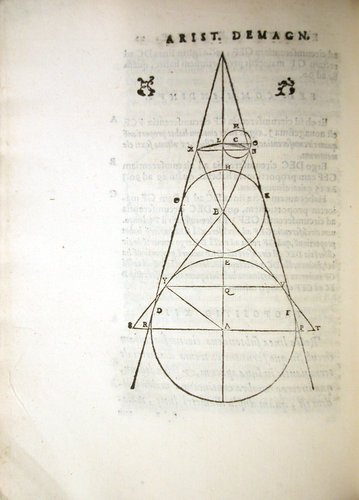 Aristarchos of Samos (early third century), another Alexandrian mathematician,
accepted Euclidean geometry and built upon it. In On the sizes and distances of the Sun and the Moon, Aristarchos first added six hypotheses
and then deduced propositions from them using Euclidean methods. While Euclidean
geometry applies only to the realm of unobservable ideals (where a line equals
breadthless length, etc.), Aristarchos associated geometrical methods with the
realm of observable natural phenomena, namely, the astronomical appearances of the Sun and the Moon. For example, his first hypothesis is
that the Moon receives its light from the Sun, and his second that the Earth
is in the relation of a point and center to the sphere in which the Moon moves.
Although these hypotheses cannot be established by simple observations, they
do associate natural phenomena with geometrical ideals in some sense, in contrast
to Euclid. The propositions deduced by Aristarchos demonstrate the power of
Euclidean methods when employed in natural philosophy.
Aristarchos thereby deduced the sizes and distances of the Sun and Moon in terms of the size of the Earth. Since Aristarchos utilized a value of about two degrees for the apparent diameter of the Moon, a fourfold overestimation, one may suspect that he was more interested in demonstrating the power and elegance of his mathematical method than in deriving a physically accurate result.
According to Plutarch and Archimedes, Aristarchos also argued that the heavens are at rest, that is, that the fixed stars and the Sun are unmoved, and that instead the Earth revolves around the Sun while rotating about its axis. Neither idea in itself was novel (Philolaos of Kroton and earlier Pythagoreans had suggested that the Earth revolves around a central fire, and Herakleitos of Pontos that the Earth spins about its axis), but since both were mathematically equivalent with a geocentric, geostatic cosmology, Aristarchos' proposal exerted little or no influence, though it did survive.
Do you have a great quote for this page? Let me know! (If used, a new quote is worth 1 point extra credit)

|
HSCI 3013. History
of Science to 17th century |
spellcheck.net | wordcounter.net
Many thanks to the pedagogical model developed in Mythology and Folklore and other online courses by Laura Gibbs, which have been an inspiration for this course.
|
|
This course is currently undergoing major reconstruction to bring it into alignment with the new version of the course at Janux |
|||


