

Foucault's Pendulum
Plan to watch the Foucault pendulum for about 2 hours, noting the
exact times when three consecutive pegs are knocked down. Complete
the pre-lab, read Crowe, sketch weird people that walk by, sing of
the joy in your heart, etc., as you wait between peg knock-downs. Sit
on the north side of the pendulum and face south. (When you face
south, east is on your left and west is on your right. The entryway
doors are on the west side of the of the Science building; the
planetarium is on the east side.) All of the questions in the lab
pertain only to the south half of the circle of pegs (disregard pegs
on north half of circle).
 Pre-Lab
-
- Try the following Yo-Yo experiment on your
own:
Use a yo-yo or tie a small object at one end of a length of
string. Swing your pendulum to and fro, holding the end of the
string in your fingers. Twist the string in your fingers as you
allow it to continue swinging.
- Does the yo-yo change its direction of swing? _______
- Does the yo-yo twist around with the string? _______
- Apply the Yo-Yo Model to the Foucault
Pendulum:
- The inertia of the yo-yo kept it swinging in the same
direction. Similarly, the inertia of the heavy pendulum bob
keeps it swinging back and forth in the same plane. The
pendulum keeps swinging in the same plane while the Earth
rotates below it. If the pendulum is like the yo-yo, the
rotating Earth is like a merry-go-round rotating underneath it.
- As with the yo-yo, the twisting of the cable-mount imparts
to the pendulum a slow spin about its axis, but this twisting
does not alter the direction of the swing of the pendulum (its
plane of oscillation).
- North Pole Thought Experiment:
- Visualize a Foucault pendulum at the north pole. Imagine
that Santa Claus is standing in the exact center of the OBU
Pendulum area, and the Earth is rotating beneath his feet. (He
does a jolly dance to avoid getting hit by the pendulum as it
swings.)
- In your mind's eye, imagine the pendulum's plane of swing
remaining the same with respect to the fixed stars. The
pendulum experiences none of the rotational motion of the
earth.
- The Earth silently rotates beneath the pendulum without
affecting the pendulum's plane of swing. Imagine the circular
row of pegs as the equator, moving counterclockwise around the
center as the earth turns on its axis. The rotation of the
earth continually pushes one peg after another into the path of
the swinging pendulum, causing the pegs to be knocked down. The
room rotates around the pendulum; eventually all of the pegs
get in its way and are knocked down.
- Although actually maintaining a constant direction of swing
with respect to the fixed stars, the pendulum
appears to change its direction with respect
to the pegs. Actually, like the pegs, we are sharing in the
rotational motion of the floor and the earth, and therefore it
is we ourselves that are moving, rather than the pendulum. We
believe ourselves to be standing still, instead of rotating
with the earth at an eastward speed of many thousands of miles
per hour.
-
- How long will it take for this north-pole pendulum to knock
down all the pegs?
- Why would the pendulum knock down all pegs twice with every
360 degrees of rotation?
- How long will it take for the floor to rotate once around
(360 degrees) beneath this north-pole pendulum?
(Definition: This is the
PERIOD of the pendulum.)
- Equator Thought Experiment:
Set a pendulum swinging north and south at the equator. Beneath a
pendulum at the equator, the ground is simply moving from west to
east, carrying the pendulum with it, not rotating independently of
it. The entire pendulum, and its plane of oscillation, shares in
this eastward inertial motion. Note that the pendulum must be
independent of the rotational motion of the earth, to some degree,
for that motion to be manifest to an observer. Since at the
equator the pendulum has no motion independent of the rotation of
the earth, it will not knock down any pegs or appear to undergo
any change of direction at all.
-
- What would be the period of a Foucault pendulum at the
equator?
Lab
Intermediate-Latitude Observation Exercise
Observe the Foucault pendulum (with explanatory display) in the
exhibit area near the entryway to the Wood Science building.
-
- When and where did Jean Foucault first perform this
experiment?
- What did Foucault prove and how did he prove it?
- What significance does this have for the acceptance of
Copernican astronomy?
- Rotational Period of the Pendulum's Plane of
Oscillation.
At a latitude intermediate between the equator and pole, such
as Shawnee, the ground beneath the pendulum undergoes a
combination of motions, both eastward (as at the equator) and
rotary (as at the pole). A Foucault pendulum at the Earth's north
or south pole would appear to move through a complete revolution
of its plane of oscillation in exactly 24 hours.
As seen from Shawnee, will a complete revolution of the
pendulum take longer or shorter than 24 hours? (Answer this before
doing the calculations below.) Explain your reasoning.
- Discover the period of our Foucault pendulum
- Data
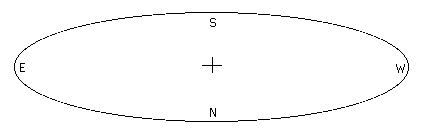
Below is a drawing of an ellipse that represents the circle of
pegs as viewed at an angle from your sitting or standing position.
Label and answer the following on this drawing:
-
- Draw a line to show where the pendulum was swinging when
you first arrived. Label the line with your time of
arrival.
- Count the total number of pegs. ____ pegs
- Mark a visible dot on the ellipse for every peg.
- Draw a short line through every dot if the corresponding
peg has been knocked down.
- Record the time beside each peg that is knocked down while
you are present. Watch the Foucault pendulum until you observe
at least 3 pegs knocked down (consecutive pegs on the same
side).
- As seen from above, which way does the pendulum appear to
be changing its "plane of oscillation"?
- ___ clockwise;
- ___ counterclockwise
- Draw a line to show where the pendulum was swinging when
you left. Label the line with your time of departure.
- Calculations
-
- How much time elapses, on average, between peg knock-downs?
_______ min/peg
- Calculate the time, shortly after the pendulum was
first started in the morning, when the first peg on the south
side was knocked down.
Multiply the time between peg knock-downs (min/peg) times the
number of pegs already knocked down before you arrived (pegs).
Subtract this product (min) from the time you first saw a peg
knocked down.
_______ a.m.
- Calculate the total amount of time required for the
pendulum to rotate through 360 degrees.
Multiply the time between peg knock-downs (min/peg) times the
total number of pegs (pegs) to obtain the period in minutes.
Then divide by 60 min/hr to obtain the period in hours.
PERIOD OF THE FOUCAULT PENDULUM:
_____ minutes
_____ hours
- Compare your value for the period in hours with the values
obtained in the Pre-Lab Thought Experiments for the pendulum at
the north pole and at the equator. Does your value for the
pendulum's period fall within these upper and lower limits? Is
your observed value consistent with the answer you gave in Lab
step 4?
For a detailed exposition of the pendulum see Henry Worms, The
Earth and Its Mechanism: Being an Account of the Various Proofs of
the Rotation of the Earth (London: Longman, Green, 1862), Part I,
ch. 6 "On the Apparent Change of the Plane of Oscillation of the Free
Pendulum," pp. 84-102.