


 |
 |
|
Platonic Theories of the Earth (the Phaedo)
 |
 |
 |
 |
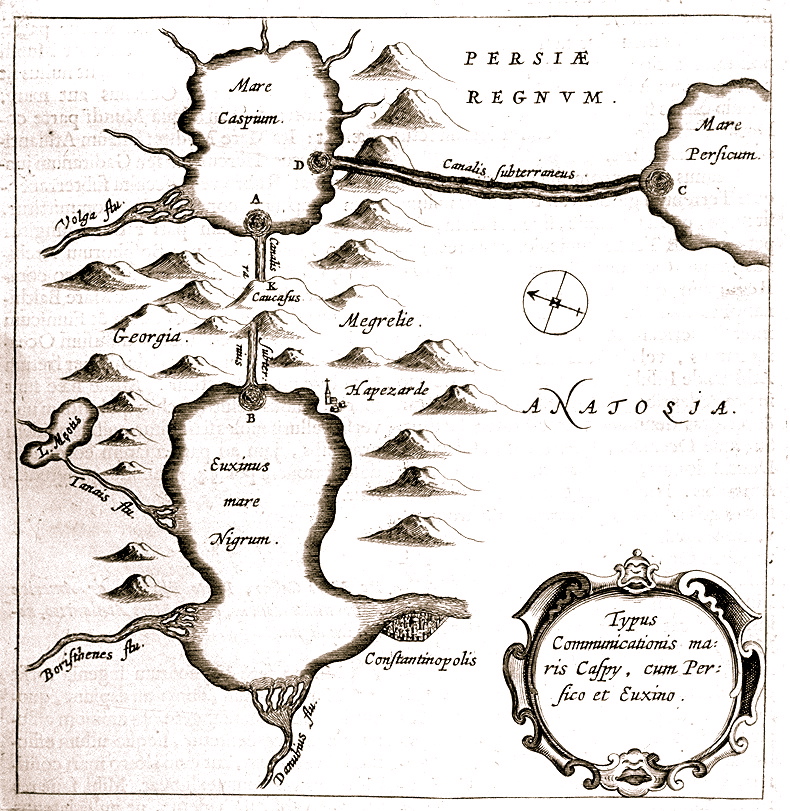
These four images are from Mundus
subterraneus (The Subterranean Earth) by Athanasius Kircher,
1665. As you read Plato's account of the Earth below, you will see how each of Kircher's images illustrates Plato's theory of the Earth. Click on any image for a larger view. |
|||
Key Concepts of Platonic Theories of the Earth
In the Phaedo, awaiting his imminent death, Socrates discounted his companions’ fears that his soul was about to wander alone through the desolate underworld of Hades. Instead, Socrates affirmed that his soul would reside in a wonderful region of the Earth (or perhaps in some region of an ideal and perfect Earth) where the inhabitants commune with the gods face to face. His companion Simmias responded: “I myself have heard a great many theories about the earth, but not this belief of yours. I should very much like to hear it.” Socrates answered that although he could easily outline his theory of the Earth, to prove that his beliefs were true might not be possible — and, in any event, would require a longer explanation than his few remaining minutes allowed. Thus, to describe his vision of the Earth in a non-demonstrative manifesto, Socrates declared that the Earth is spherical, that it lies in the middle of the heavens, and that its size is vast, containing many different, completely unknown regions.1
In the Timaeus (55c), Plato suggested that the ideal Earth is spherical, but the actual material Earth is only roughly spherical, a dodecahedron or twelve-sided figure which might be the closest approximation to the Form of a sphere that earthy matter is capable of assuming. So the Earth from space, according to Socrates, might look something like a soccer ball: spherical, yet with hollow regions like the inhabited areas surrounding large seas, like the Mediterranean Sea and the Caspian Sea. These hollow regions would appear from space to flatten out some patches of the globe.
“Well, my dear boy, said Socrates, the real Earth, viewed from above, is supposed to look like one of these balls made of twelve pieces of skin, variegated and marked out in different colors....”
(Plato, Phaedo, 110b, Hamilton and Cairns, 91.)
In other words, Socrates suggests that the Earth, if viewed as a globe from space, would display a patchwork of 12 flattened or hollow regions. Later, the Roman-era writer Plutarch argued that just such a view is presented to us on the face of the Moon: “let us not think it an offence to suppose that she [the Moon] is Earth and that for this which appears to be her face, just as our Earth has certain great gulfs, so that Earth yawns with great depths and clefts which contain water or murky air; ...”2
Within
the Earth, Socrates continued, there pulses an internal circulation
of water and fire, continuous with the land on the surface:
In the earth itself, all over its surface, there are many hollow regions, some deeper than our [Mediterranean] region but with a smaller expanse, some both shallower than ours and broader. All these are joined together underground by many connecting channels, some narrower, some wider, through which, from one basin to another, there flows a great volume of water — monstrous unceasing subterranean rivers of waters both hot and cold — and of fire too, great rivers of fire, and many of liquid mud, some clearer, some more turbid, like the rivers in Sicily that flow mud before the lava comes, and the lava stream itself.
(Plato, Phaedo, 111d, Hamilton and Cairns, 92.)
Relying upon the testimony of the poets, Socrates supposed that one subterranean system is formed as the Acheron river flows into a subterranean Acherusian Lake, a meeting place for the souls of the dead. Another system is comprised of the dreadful Cocytus River and its associated lake, the Styx, which holds waters with mysterious powers. The Pyriphlegethon River, a fiery stream from which lava arises, spirals down toward Tartarus, which runs through the center of the Earth:
All this movement to and fro is caused by an oscillation inside the earth, and this oscillation is brought about by natural means, as follows. One of the cavities in the Earth is not only larger than the rest, but pierces right through from one side to the other. It is of this that Homer speaks when he says, ‘Far, far away, where lies earth’s deepest chasm,’ while elsewhere both he and many other poets refer to it as Tartarus.3
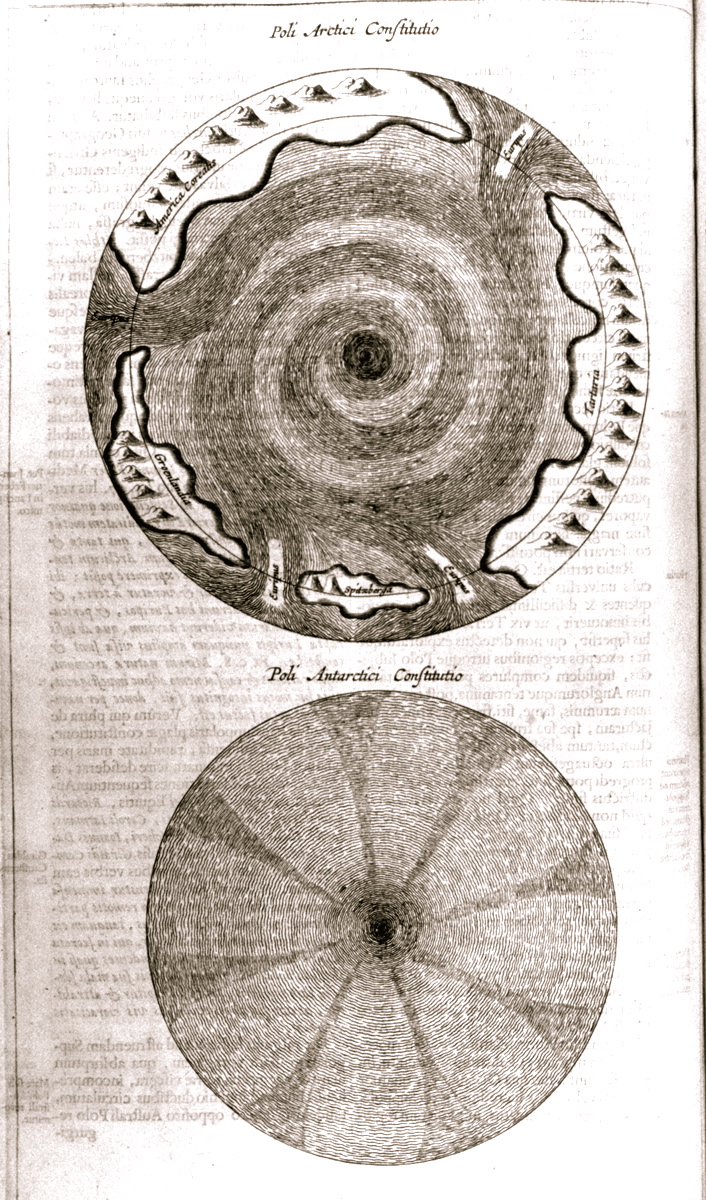
Athanasius
Kircher reproduced twin maps
of the great polar whirlpools which he thought must serve as
entrances to Tartarus. Plato's suggestion that the poles would
offer entrances to subterranean worlds fueled interest
in polar exploration through the 19th century.
Kircher, Mundus Subterraneus (1665).
Plato explained that bottomless waters pulse back and forth through the central Tartarus (Tartaron), flowing from one side of the Earth to the other, acquiring various properties from the qualities of the earths through which they pass. The tides therefore move in a continual rhythm much like the breath of a man:
Into this gulf all the rivers flow together, and from it they flow forth again, and each acquires the nature of that part of the earth through which it flows. The cause of the flowing in and out of all these streams is that the mass of liquid has no bottom or foundation, so it oscillates and surges to and fro, and the air or breath that belongs to it does the same, for it accompanies the liquid both as it rushes to the further side of the earth and as it returns to this. And just as when we breathe we exhale and inhale the breath in a continuous stream, so in this case too the breath, oscillating with the liquid, causes terrible and monstrous winds as it passes in and out.
(Plato, Phaedo, 112a–b, Hamilton and Cairns, 92–93.)
The analogy between the tides and breathing is only one of many vitalistic resemblances Plato discerned between the human body and the Earth as microcosms, and the living universe as the macrocosm. Such macrocosm-microcosm analogies continued to be typical of Platonist and Neoplatonist views of the Earth through early modern times. For example, this quotation from the early modern astronomer Johann Kepler illustrates Neoplatonic macrocosm-microcosm analogies:
"For as the body puts out hairs on the surface of its skin, so the Earth puts out plants and trees; and lice are born on them as in the former case, caterpillars, cicadas, and various insects and sea monsters as in the latter. As the body displays teats, mucus, and earwax, and also in places lymph from pustules on the face, so the Earth displays amber and bitumen; as the bladder produces
excrement of sulphurous odor and farts which can even be set on fire, so the Earth produces sulphur, subterranean fires, thunder, and lightning; and as blood is generated in the veins of an animate being, and with it sweat, which is thrust outside the body, so in the veins of the Earth are generated metals and fossils, and rainy vapor."
(Kepler, Harmonices mundi, 1619; Harmony of the Universe, trans. E. J. Aiton, A. M. Duncan, and J. V. Field, 1997, pp. 363–364).
For Plato not rainfall but the pulsing subterranean movements of water through the Earth provide the source of surface seas, lakes, rivers, springs:
So when the water retires to the so-called lower region the streams in the earth flow into those parts and irrigate them fully, and when in turn it ebbs from there and rushes back this way, it fills our streams again, and when they are filled they flow through their channels and through the earth; and arriving in those regions to which their ways have been severally prepared, they make seas and lakes and rivers and springs.
(Plato, Phaedo, 112c, Hamilton and Cairns, 93.)
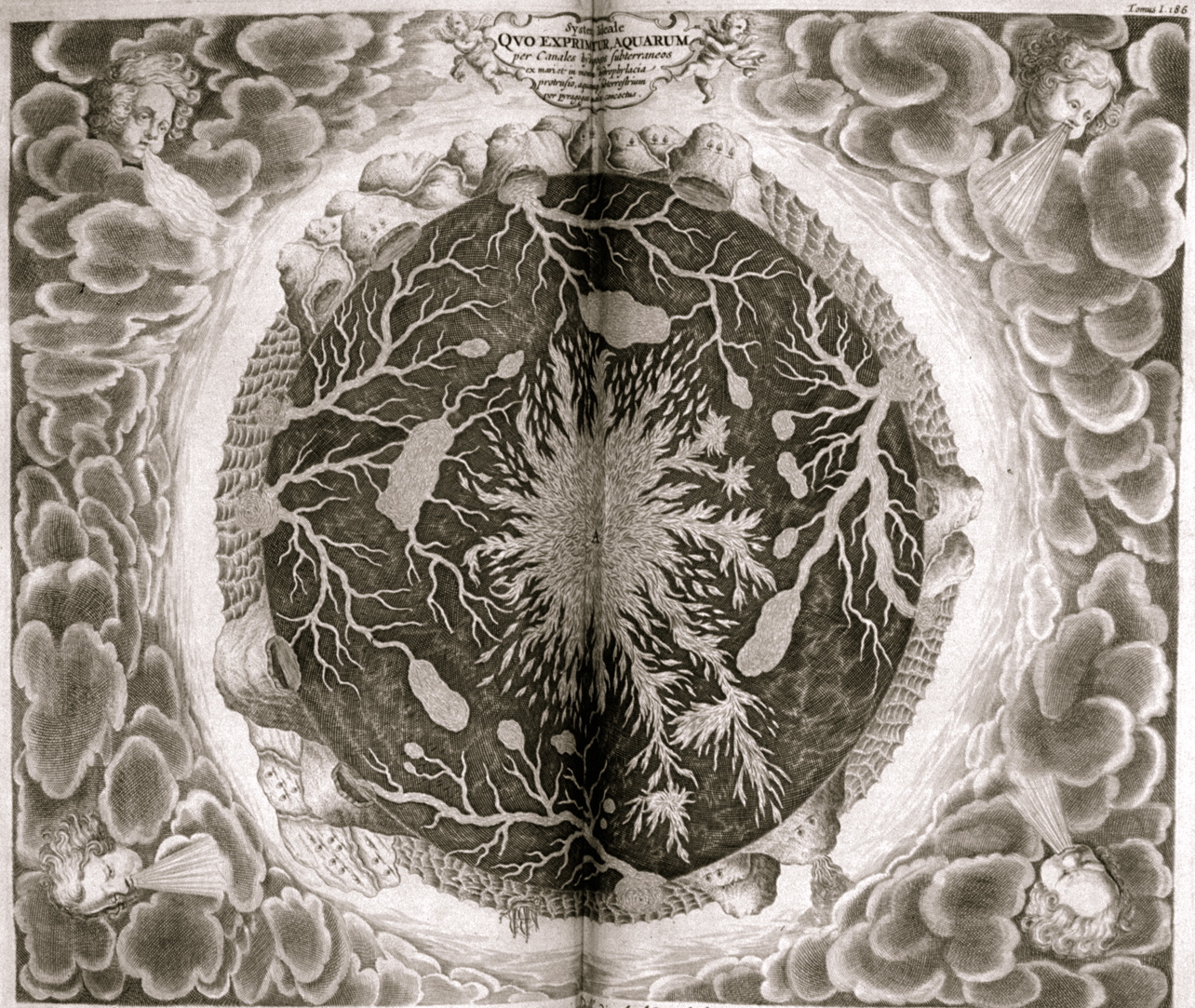
Left:
Kircher's depiction of underground passageways,
subterranean channels that allow water to pass
from one place to another within the Earth.
According to Plato, the waters drain through complex, winding passageways throughout the Earth:
"Then sinking again beneath the ground, ... they empty themselves once more into Tartarus, some much lower, some only a little lower than the point at which they were emitted, but they all flow in at a level deeper than their rise. Some flow in on the opposite side to that on which they came out, and others on the same side, while some make a complete circle and, winding like a snake one or even more times round the earth, descend as far as possible before they again discharge their waters."
(Plato, Phaedo, 112d, Hamilton and Cairns, 93.)
Plato’s next sentence confirms that he conceived of the Earth as roughly spherical: “It is possible to descend in either direction as far as the center, but no further, for either direction from the center is uphill, whichever way the streams are flowing” (Plato, Phaedo, 112e, Hamilton and Cairns, 93.)
Right:
Kircher's depiction of the lost island
of Atlantis. Kircher regarded Atlantis as a continent
midway between the old world and the new.
His map is upside down by modern conventions:
north is at the bottom, and south is at the top.
Africa and Spain are shown at left;
America to the right.
Crustal Collapse: The Atlantis Myth
Plato's idea of subterranean circulations through underground passageways almost inevitably raises the possibility of crustal collapse. Indeed, changes in the Earth due to episodes of crustal collapse are the essential conceptual characteristic defining Platonic theories of the Earth.
This concept is found in a famous passage of the Timaeus, where Plato envisioned the occurrence of many diverse catastrophes in the Earth’s past: “There have been, and will be again, many destructions of mankind arising out of many causes; the greatest have been brought about by the agencies of fire and water, and other lesser ones by innumerable other causes.”
Plato’s account of the collapse and destruction of Atlantis is found in the Timaeus, 21b–27a. Atlantis also constitutes the entire subject of the unfinished Critias. In particular, Plato recounted the total destruction of a great civilization, all memory of which had been obliterated when it suddenly sank beneath the waves: “But afterward there occurred violent earthquakes and floods, and in a single day and night of misfortune all your warlike men in a body sank into the earth, and the island of Atlantis in like manner disappeared in the depths of the sea.” 4
Many scholars and scientists now explain Plato's Atlantis story as a retelling
of the dimly remembered destruction of the pre-Greek Mycenaen culture when the
Aegean island of Thera erupted in a super-volcanic explosion. Here is a blurb
from an episode of Lost Worlds (History Channel) devoted to the search
for a historical Atlantis: "In the heart of the Mediterranean a peaceful
island explodes with devastating force - it will be the biggest volcanic eruption
in three and a half thousand years of recorded history. At a stroke, an entire
civilization is wiped from the face of the earth and lost. All that remains
are stories." Yet before the 20th century, many scholars like Kircher identified
Atlantis and its lost civilization not merely with Mediterranean cultures but
with places all over the world, from Sweden to the New World. Optional:
Watch the Atlantis music video by the 1960's group Donovan at You Tube, and/or the excellent Atlantis episode of Lost Worlds
at iTunes
 .
Just as Homer belonged to every Hellene, so a conception of the Earth as laced with internal passageways supporting various elemental circulations, often continuous with the heavens, often associated with vitalistic microcosm-macrocosm analogies, and often associated with changes in the Earth due to events of crustal collapse, became a commonplace of poets, natural historians such as Pliny, Stoics such as Seneca, Epicureans such as Lucretius, various hermetists, hexameral commentators, et al., rather than the exclusive possession of Platonism. There were notable dissenters, such as Aristotle. Yet despite exceptions, a number of ancient visions echoed Plato’s views of the Earth. Although the Phaedo is often ignored in treatments of ancient geological thought, it was well-known to early modern readers, providing a particularly significant idiom that helped disseminate Platonic theories of the Earth.
Notes:
1. Plato, Phaedo, 108c-109b; trans. Edith Hamilton and Huntington Cairns, The Collected Dialogues of Plato, Including the Letters, Bollingen Series LXXI (Princeton: Princeton University Press, 1961), 90. Plato’s main account of the interior of the Earth, with its various passageways and circulations, is found in the Phaedo, 108c–113c. On communing with the gods face to face, cf. Phaedo, 111c.
2. Plutarch, “Concerning the Face which appears in the Orb of the Moon,” in Plutarch’s Moralia, trans. Harold Cherniss, vol. 12, 16 vols., Loeb Classical Library, no. 406 (Cambridge: Harvard University Press; London: Heinemann, 1957), 935c, p. 143. In writing this work, which argues throughout for an Earthlike Moon, Plutarch is widely regarded as indebted to Plato’s Timaeus. A related passage is found at 944c (p. 209): “just as our earth contains gulfs that are deep and extensive, one here pouring in towards us through the Pillars of Hercules and outside the Caspian and the Red Sea with its gulfs, so those features are the depths and hollows of the moon. The largest of them is called ‘Hecate’s Recess,’....” Scott Montgomery cites this passage as “the very first evidence of an effort to name some of the visual features on the lunar surface”; Scott L. Montgomery, The Moon and the Western Imagination (Tucson: University of Arizona Press, 1999), 34.
3. Plato, Phaedo, 111e–112a, Hamilton and Cairns,
92. The Acheron, Pyriphlegethon, and Stygian rivers are described in Phaedo,
113, as well as in many writers before and after Plato. The subterranean geography
of Homer is vague, but see Book XI of the Odyssey for suggestive remarks
about the activities of shades in the realm of Hades. Hesiod’s Theogony
described a war with the Titans who in the end were confined to a dark region
inside the Earth called Tartarus (Theogony, 713–814; for an interesting
interpretation of Zeus’s war
with the Titans as based upon the explosive eruption of Santorini [Thera] circa
1470 BC see Mott T. Greene, Natural Knowledge in Preclassical Antiquity
[Baltimore: Johns Hopkins University Press, 1992], chapter 3). Plato also referred
to Tartarus as an abode of the wicked in torment after death in the myth of
Er in the last book of the Republic, 614b-617d (this passage contains
a number of images with a long history in Neoplatonic cosmology, including a
description of the universe as eight nested spheres, rotating in harmony, suspended
by necessity from a chain of light). Virgil mentioned the Styx, Acheron, Lethe,
Cocytus, and Pyriphlegethon rivers in Book VI of the Aeneid.
4. Hamilton and Cairns, 1157 and 1159-1160; The fascination of the Atlantis myth apparently is perennial: few are the Renaissance scholars who omitted to comment on it, and few are the places never to have been identified with it; for example, in the seventeenth-century Olaus Rudbeck argued that his native Sweden was the lost island (or peninsula) of Atlantis; Gunnar Eriksson, The Atlantic Vision: Olaus Rudbeck and Baroque Science, ed. Tore Frängsmyr (Canton, MA: Science History Publications; Watson Publishing International, 1994). Modern geological interpretations of Plato’s Atlantis myth are reviewed in Dorothy B. Vitaliano, Legends of the Earth: Their Geologic Origins (Bloomington: Indiana University Press, 1973), chapter 9. For invaluable commentary on the relation of the Atlantis myth to Plato’s thought as a whole see James S. Romm, The Edges of the Earth in Ancient Thought: Geography, Exploration, and Fiction (Princeton: Princeton University Press, 1992), 124–128.
"Astronomy compels the soul to look upward, and leads us from this world to another." Plato, The Republic

|
HSCI 3013. History
of Science to 17th century |
spellcheck.net | wordcounter.net
Many thanks to the pedagogical model developed in Mythology and Folklore and other online courses by Laura Gibbs, which have been an inspiration for this course.
|
|
This course is currently undergoing major reconstruction to bring it into alignment with the new version of the course at Janux |
|||


