

A Liberal Arts Vision
for a University Planetarium
by Kerry Magruder
| Preceding page: What is a
Planetarium? |
Who am I? Why did I write this?
- From Fall 1994 through Spring 1998 I was Professor of
Natural Science and Planetarium Director at Oklahoma Baptist
University.
- A planetarium theater contributes much to the academic life of
a liberal arts university, so I've written this page to explain
what we did and why we did it!
What is a planetarium?
- First read What is a planetarium?,
written to precede this page.
When and where did you do
it?
Construction of a planetarium represents a major, long-term
commitment on the part of many people, including university planners,
administrators, physical plant engineers and craftsmen, and technical
specialists familiar with the special challenges of planetarium
design. At OBU the process involved the following stages:
- The W. P. Wood Science Building, completed in 1985, included
plans for a planetarium theater on the ground floor. A special
room was built at that time with a suspended aluminum dome
overhead, 8.25-meters in diameter.
- In 1994, a Professor-Director (yours truly) was hired to
coordinate planetarium design and installation.
- It is imperative that a university bring an experienced
planetarium director on board as early as possible during the
planning stages. Don't wait until the facility has already been
constructed!
- The room was remodelled by OBU Physical Plant personnel in
early 1995.
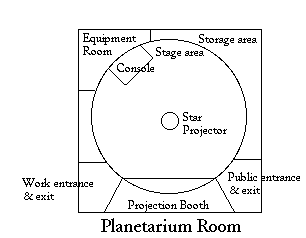
- A circular gallery wall and rear projection booth were
constructed.
- A new power panel and 40 electrical circuits were carefully
planned and installed.
- Considerable attention was given to HVAC improvements
essential for creating an appropriately quiet theater
environment and for handling the large quantity of heat
produced by both equipment and people.
- For pedagogical reasons, seating capacity was set at 25
persons, with the console and a demonstration/stage area at the
front. (A 10-meter dome would allow comfortable, adult-size,
unidirectional seating for 35-40 people.)
- A Goto GS-T star projector was built by Goto Corporation of
Japan and installed in May of 1995.
- Initial installation of auxiliary equipment was completed by
early fall of the same year. This equipment included multiple
slide projectors, special effects projectors, and state of the art
video and digital sound systems, all seamlessly integrated with
the planetarium automation system.
- University classes and other groups began coming for special
shows, laboratories, and activities throughout the 1995-96
academic year and thereafter.
 Why
should a liberal arts university construct a planetarium
theater?
The OBU Planetarium is uniquely defined by its liberal arts
mission, as the only university-based planetarium in the state of
Oklahoma. Unlike most planetariums, it does not function as a part of
a commercially-operated science museum with programs designed
primarily or exclusively for elementary ages. Moreover, it is unique
even when compared with other university-based planetariums across
the country, which typically serve either a supporting role for
graduate-level astrophysics programs, or function as an adjunct to
the academic programs of the university (comparable to, say, athletic
programs) by providing elementary-school shows as a service to the
community with long term goals of recruitment, public relations,
and/or revenue enhancement.
I was determined that, at its heart, the OBU Planetarium express
the liberal arts mission of the university. We designed the
planetarium to provide unique educational experiences across the
curriculum for undergraduate students. A planetarium is not just a
science toy, or a high-tech entertainment center. Its educational
possibilities contribute to a liberal arts university, beginning with
all areas of natural science and science education and extending to
the humanities as well. This is the meaning of the motto adopted by
the OBU Planetarium (taken from an emblem of Tycho Brahe):
Svspiciendo Despicio or, Looking up, I look down. By
coming into the planetarium and "looking up," we believe liberal arts
students find illumination to more perceptively "look down" at
whatever they explore in the terrestrial world outside the
planetarium.
The liberal-arts mission of the OBU Planetarium was immediately
manifest in two fundamental characteristics, which became evident in
all we did during my tenure as Director:
- PROFESSOR-DIRECTOR:
The first Director (yours truly) was a professor, which proved
essential for the planetarium's integration into academic
programs. The Director carried a half-time teaching load in the
Natural Sciences Division, in addition to supervising the ongoing
operations of the planetarium. Having a professor-director ensures
that colleagues enjoy open access to the planetarium for their
classes and other events, and that they are provided with needed
technical support. A professor-director ensures that planetarium
activities reflect academic priorities.
- STUDENT STAFF:
The planetarium is student-staffed, which provides work-study
employment and undergraduate research opportunities for students
with a variety of interests and majors (at OBU student workers
included English, History, Education, Psychology, and Computer
Science majors as well as Science majors). The first audience
is always university students, as student workers produce
programs of their own choosing, and present them to their peers in
a variety of settings (science classes, humanities classes, Friday
night public shows, etc.). For this reason, at OBU our shows were
designed to interest adults, not just elementary children (even
our shows for elementary children were interesting enough to hold
our students' attention!). Our "serve students first" policy was
in effect even when presenting shows to outside groups (elementary
classes, public shows for the community, university alumni at
homecoming, etc.), because it was students who select, develop,
and present the shows.
(Note: These two points are not meant to be an exhaustive list
of staff. Although we provided our own secretarial and even
janitorial support, the Science Division Secretary was regularly
indispensable! And most importantly, a full time Planetarium
Technician staff position would have been nice, even highly
advisable, but it was not funded during my tenure.)
It should be evident, from a moment's reflection on both of the
above characteristics, that a liberal arts planetarium is not a
money-making operation. The OBU Planetarium is class-sized, to
enhance pedagogy rather than the bottom line. Although we did try to
recoup some of our expenses, from the beginning it was clear that our
mission was not to increase revenues, but to serve the academic
programs of the university, and then to make those academic resources
accessible to the community.
How:
Target Audiences
A target consists of nested concentric circles. If the planetarium
theater is the bull's eye at the center, each circle represents the
various audiences served by the facilty, one after another. As a
liberal arts planetarium expands its reach into a broad spectrum of
educational roles, the following audiences are targeted:
Circle 1: Science majors
A planetarium provides an ideal and unique opportunity for
students to explore natural science. As the "inner ring" of the
planetarium's "target," every student majoring in science benefits
from the planetarium:
- Most obviously, many science majors find that the planetarium
enhances their own academic programs, either by planetarium
labs or by putting their knowledge to work in practical
projects.
- Of course, the most direct use of the planetarium may be
for Astronomy and Physics students. No other
setting compares with a planetarium for teaching celestial
motions, observational astronomy, celestial mechanics, and even
some aspects of modern cosmology.
- In addition to these courses in natural sciences, students
taking classes in History of Science, Computer
Science and Mathematics (particularly geometry and
statistics) are directly served by planetarium instruction and
operation.
- It makes sense for the planetarium director to be a
professor in one or more of these areas.
- Perhaps it is not immediately obvious how
students majoring in other areas of natural science benefit from
the planetarium, even indirectly. However, the OBU Planetarium
served the entire science division as a state-of-the-art
multi-media theater.
- Planetarium programs with special effects and
whole-dome images are useful for Biology and Chemistry
students as well, not just for the fields listed above.
- Imagine an introductory cellular Biology lab taking a
virtual tour of a cell, starting off by being
surrounded by a whole-dome image of a cell, then dissolving
into views of organelles and other structures.
- Or an introductory Chemistry lab gaining familiarity
with exponential numbers by a virtual tour of the
universe, starting with life-size pictures of themselves
and stepping, by one power of ten at a time, all the way out
to galaxies and quasars, or all the way down to atoms and
quarks.
- Courses such as Ecology and Earth Sciences meet in the
planetarium for educational videos, projected
computer simulations, and multiple slide or
PowerPoint illustrated lectures.
- Science students use the planetarium theater for special
presentations to their peers for classes, senior theses,
and science clubs.
- Real-time long-distance video-conferencing is also
possible through a satellite feed.
Circle 2: Natural Science courses for Liberal Arts
students
The planetarium provides all students with a compelling
reason to frequently visit the science building!
- In their junior year at OBU, liberal arts students with
non-science majors take a uniquely-designed course in the Unified
Studies core, Natural Sciences
311, which explores problem-solving in the history of
astronomy, cosmology and physics, especially in the Copernican
Revolution. In this course, planetarium labs are used for
instruction in observational astronomy, cosmology, planetary
motion, and classical mechanics.
- In the Planetarium
Operations course, students of a great variety of interests
and backgrounds learn the constellations and skylore, as well as
how to use a telescope, and how to operate the star projector and
basic multimedia systems. To gain a sense of familiarity with the
night sky is a widespread desire, and its achievement (not
difficult in this course) provides students with rewards for a
lifetime. The technical training, although basic, is also useful
for students with a variety of disciplinary contexts and career
interests.
Circle 3: History of Science
OBU offers two general survey courses in the history of science,
GNSC 312 (to Newton) and 313 (after Newton). A planetarium enhances
instruction in the history of science from archaeoastronomy to
Copernicus to the present (though few planetaria at present have the
scholarly resources to orient their programs within a history of
science perspective).
- See the Cosmology
and Cultures project website.
- Note that the physical components of the star projector itself
embody the geometrical devices used in ancient earth-centered
astronomical theories!
Circle 4: Science Education and other Education
students
A planetarium theater offers unparalleled advantages to
education and science education majors.
- The planetarium serves as a pedagogical training
ground, as lesson plans and activities are created by
students, and then presented by them to elementary or secondary
classes invited to the planetarium. Students gain valuable
experience in collaborative learning, while the planetarium
provides opportunities to carry out class projects, engage in
undergraduate research, or find beneficial employment in which to
hone their professional skills.
- The Planetarium
Operations course is of particular interest to education
students as a media course cubed. Diverse educational
technologies are involved in the production of a planetarium show,
and the planetarium serves as a valuable resource facility for
students in educational technology courses.
Circle 5: Humanities, fine arts, and other university
classes
A planetarium is a "magical place," transforming the imagination
as well as the mind. A planetarium theater, made accessible with
sympathetic and professional assistance to students in the fine arts
and humanities, enhances the quality of learning across the
curriculum.
- Fine Arts
- Poetry readings, choir performances, musical concerts,
and theatrical or artistic events take place in the
planetarium, accompanied by appropriate displays of the starry
sky. The planetarium's sound system and acoustics make it an
attractive facility in which to offer live performances.
- Live performances may be combined with special
planetarium events such as seasonal shows exploring
traditional music, stories, and star-lore of winter, spring,
summer or fall (see Starstruck
Tonight, Follow the
Drinking Gourd, More than
Meets the Eye).
- In its first years the OBU Planetarium hosted a brass
quintet performance as part of the Bison Hill Arts Festival
and a student theatrical production entitled "Let us go into
the Starry Night."
- The digital recording capabilities of the
planetarium are regularly made available to university
musicians, dramatic readers, and other interested groups
for various academic projects (the end product can be a master
digital tape or pressed CD of their performance; cf. Planetarium
specs).
- History and Literature
- The astronomy and cosmology assumed or referred to by
writers such as Aristotle, Dante, Chaucer, Milton, or Hardy can
be far more effectively presented in a planetarium than a
classroom lecture.
- Ancient mythology can be studied in tandem with
constellations representing particular stories, observed both
in the planetarium and then outside in a guided star-watch
(with or without binoculars and telescopes).
- See the Cosmology
and Cultures project for many, many more ideas!
Circle 6: Academic Life
Beyond the curriculum itself, the planetarium contributes further
opportunities for academic life on campus.
- Its regular public shows add a new dimension to student
life, as a unique medium for the exploration of broad world-view
questions often addressed in our culture not through specialized
academic courses so often as by imaginative cosmic visions (see
The Mars Show for an
example).
- Symposia and other special events are also held
in the planetarium (see examples listed in Circle
1 and Circle 5 above).
- Shows for campus visitors, including alumni and
prospective students, reflect the vibrancy of academic life all
the more because of the conspicuous role of students in each
aspect of planetarium operation. Students are the face of the
university planetarium.
Circle 7: Area Elementary and Secondary level science
programs
The planetarium makes the academic resources of the university
available to serve the community and region, as students offer
educational programs for families on Friday nights and by
arrangement, and for elementary or secondary students during school
hours. School shows, created and presented by education majors or
other interested students, share a number of characteristics:
- Hands-on, interactive programs for various age groups.
- Designed to complement grade-specific curricula, such as 8th
grade earth sciences.
- Coordinated with classroom curriculum, with pre-visit and
post-visit lesson activities provided to educators to increase the
effectiveness of Planetarium instruction.
- Shows preserve a small-classroom feel with a smaller and more
personal learning environment, featuring live interaction with a
presenter-teacher (i.e., the Director or student presenters,
including education, communication, or English majors).
- Shows emphasize active-learning experiences, employing
instruments such as paper sundials and star-wheels, cardboard
astrolabes and spectroscopes, plastic protractors, golf ball
moons, planet globes, etc.
- Shows also include multi-media modules to present particular
explanations with greatest impact, using video and audio systems,
along with auxiliary slide projectors with various special effects
not inferior to commercial planetariums.
An elementary
and secondary educational website is under construction to
support primary and secondary teachers with learning activities for
their own classrooms. Secondary teachers also will find many helpful
activities in the Basic Celestial
Phenomena website. These websites are also useful for families
who visit planetarium events (Circle 8 below), and for interested
browsers from literally around the world. Students share
responsibility for responding to email inquiries generated by these
websites.
Circle 8: Public family-oriented educational
programs
Area families are invited to the planetarium for special evening
shows and weekend activities. These include:
- Feature planetarium programs for the general public:
shown regularly on Friday nights, followed by telescopic
star-watches, weather permitting. These self-contained and
carefully-produced programs are appealing and educational for a
general adult audience, including university students. Some are
commercially-prepared shows (e.g., Cowboy
Astronomer, featuring storytelling by Cowboy Poet Baxter
Black), and others are developed in-house.
- Activities for pre-schoolers and their parents to acquaint
them with the sky: distributed at the planetarium and on the
websites listed above.
- Sky-watch evening workshops utilizing the planetarium,
telescopes, binoculars, and make-them-yourself aids such as
astrolabes, sextants, or sundials are provided at amateur
astronomer training sessions and regular public star-parties
hosted by the planetarium.
- Informative programs about current astronomical events (recent
examples include comets, collisions, eclipses, etc.).
Now the target is complete....
Svspiciendo despicio!
 ©1999
Written by Kerry Magruder. Readers
should be aware this is not an OBU page, and nothing written on this
page is officially endorsed by OBU. For comparison, if you wish, an
earlier
version of this page is still posted on the OBU Planetarium
website.
