

 A
planetarium is a room with a dome-shaped
ceiling. At the center of the room is a star
projector, which projects points of light representing the
stars and planets onto the dome to simulate the night sky for any
time of night, any day of the year.
 Many
people confuse planetariums and observatories: the
latter are dome-shaped houses that contain
telescopes for observing the skies (left). Many
planetariums do have telescopes and sponsor star-gazing parties, but
the essential feature of a planetarium is the star projector, not the
telescope.
Click the planetarium drawing (right)
to go to the Loch Ness world-wide
directory of planetariums.
The star projector is just the beginning. To give you an idea of their variety let's contrast three kinds of planetariums based on their target audiences and potential uses:
A minimalist configuration of a planetarium would consist of a domed projection surface and a star projector. A minimalist facility would suffice for teaching the basic celestial motions, names of constellations, locations of stars, and principles of celestial navigation. For just these kinds of purposes, in the decade after Sputnik, federal funding enabled many American schools to install planetaria featuring economical Spitz star projectors. More recently, many school districts have begun using portable planetaria such as StarLab to project a star-field and special effects within an inflatable dome. The entire set-up is very effective, economical (about $10,000, with one full-time staff person), and can be carried from school to school as needed.
Many of the larger commercial planetariums feature high-tech entertainment under the planetarium dome. Laser shows, with their brilliant, ever-changing light patterns, are choreographed with rock and roll music, sometimes incorporating space themes. Or complicated graphics, created with laser systems such as Digistar, provide near virtual-reality experiences, such as warp-speed space travel from galaxy to galaxy beyond the Milky Way. While any planetarium operator would be thrilled to work with Digistar, these "edutainment" uses generally fall outside of the liberal arts context of a university planetarium. Also, these facilities cost several tens of millions of dollars to construct, and require a dozen experienced production and multi-media specialists to operate. When based in a university or community college rather than a commercial museum, they are rarely found outside the "space coast" of Florida or constructed apart from other aerospace industries. Fortunately, a liberal arts university does not need to rely solely on popular appeal or the tyranny of the ticket booth for financial support, but may devote a university planetarium to educational use broadly construed.
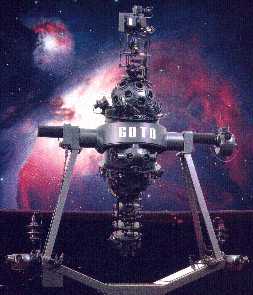
The Goto GS-T Star Projector
The OBU Planetarium represents a golden mean between the two above categories, or perhaps an alternative category altogether. It is not a high-tech science toy or entertainment center, but at the same time it is not a simple facility with merely occasional and limited use. The first Planetarium Director (yours truly) was a professor, which emphasizes the academic liberal arts vision of the facility, while a staff of student workers allows for the ongoing production of a variety of shows and activities. Although the minimalist uses described above are important and essential aims, the OBU planetarium, with its high-tech dome and powerful star-projector, is capable of far more versatile educational programs, and of more appealing, carefully-produced public shows, which could not be produced with minimalist systems. A student who became familiar with a planetarium at his or her high school will not be disappointed with the OBU theater. To reach a wide variety of educational audiences, a university planetarium can take advantage of recent trends in planetarium design:
"In recent years the design of new planetariums has been marked by sweeping changes and improvements in planetarium technology. Now most programs in larger planetariums are totally automated, require banks of special effect projectors, and feature a variety of state-of-the-art audiovisual equipment. The opportunity for new and innovative planetarium design has never been greater." So You Want to Build a Planetarium (International Planetarium Society), p. 1.
Multiple slide projectors are necessary for the normal operation of most planetarium programs. Panorama and other slide projectors, and dedicated special effects projectors (including video) are used by different shows in a variety of combinations. These projectors enable a planetarium to serve as a multi-media theater that can support a university's educational aims and at the same time present most commercially-prepared planetarium programs. (Cf. Planetarium specs.)
Next page: Understand the liberal arts vision of a university planetarium.
 ©1997
Written by Kerry
Magruder