


 |
 |
|
Egyptian Mathematics
| Egypt assignment index page | Intro | Pyramids | Calendar | Mathematics | Medicine |
In Hellenistic and Roman eras it was common to attribute great accomplishments in astronomy and the mathematical sciences to the ancient Egyptians. However, these legends are all disproved by the inherent limitations of Egyptian arithmetic.
Like Roman numerals, Egyptian numbers had no place value. (Reminder: see last week's explanation of Babylonian place-value mathematics.) For us today, it is relatively trivial to multiply 25 by 21. But how would you multiply XXV by XXI? (No converting into place-value numbers allowed!)
If you were an Ancient Egyptian, you would perform all multiplication and division through a process of addition. (You may be saying, "What?" If so, read on!) Here's how: To multiply 25 x 21 they would proceed by consecutive duplications:
Step |
# |
|
| A |
1 |
25 |
B |
2 |
50 |
| C |
4 |
100 |
D |
8 |
200 |
| E |
16 |
400 |
F |
21 |
525 |
In Step A, one 25 is equal to 25. In Step B, the 25 is doubled, so that two 25's equal 50. In Step C, the previous result is doubled, so that four 25's can be seen to equal 100. In Step D, the previous result is again doubled, so that 8 25's can be seen to equal 200. Another duplication in Step E shows that 16 25's equal 400.
Now one is prepared to calculate 21 25's. To get 21 in the # column, one needs to add the numbers in the # column for rows A, C and E. That is, 1 + 4 + 16 = 21. The result of the calculation will appear in the third column when the same rows are added: 25 + 100 + 400 = 525.
Pretty smart! But also pretty needless, if one has the option of a place-value system of mathematics like the Babylonians. However, the method does work, and some computer programs today actually perform calculations in this rather round-about way.
Using Egyptian numbers, fractions were extremely painful. For school children today, it is relatively trivial to multiply 4/5 times 3/4. On the other hand, can you imagine how you might solve a problem like IV/V * III/IV, without converting into Arabic numerals?
Ancient Egyptian calculators employed tables of unit fractions, involving only 1/5, 1/4, etc., and solving for other fractions by a process of addition. Using these tables to perform complex calcuations was obviously a task suited only for the specialist. And even for the specialist, extensive astronomical calculations of the sort underlying Mesopotamian achievements in planetary astronomy would have been impossible.
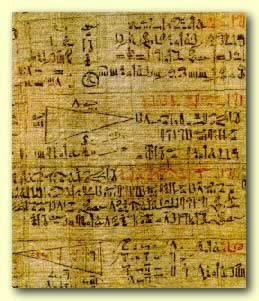 The
Rhind papyrus (right, image from Tour
Egypt) contains a table of unit fractions and their doubles. It dates from
1660 B.C., but is a copy of an original from ca. 1800 B.C.
The Rhind papyrus was a computing textbook for practical engineering. A specialist could learn to answer questions such as, "How much dirt will be needed for a ramp?" It served as a guide for surveying, for calculating the areas of fields, or for allocating the distribution of beer to temple officials. A specialist could calculate the volume of a cylinder granary or of a flat-topped pyramid.
Both the Egyptians and the later Romans prove that the most demanding economic needs in antiquity could be met by such an arithmetical system, without place-value. Administration of commerce, like navigation and engineering, was mostly an art accomplished by a "let’s try it and see" method. Solutions were not generalized; nor proven in a geometrical sense. However, Egyptian arithmetic remains of significant historical interest.
Listen to the Rhind Mathematical Papyrus episode from the British Museum's History of the World in 100 Objects.

The classic and still essential introductory survey of Mesopotamian and Egyptian mathematics and astronomy is Otto Neugebauer, The Exact Sciences in Antiquity (Providence: Brown University Press, 1957).
J.J. O'Connor and E.F. Robertson have a helpful series of web pages, Overview of Egptian Mathematics, Mathematics in Egyptian Papyri, Egyptian numerals,
| Egypt assignment index page | Intro | Pyramids | Calendar | Mathematics | Medicine |
Do you have a great quote for this page? Let me know! (If used, a new quote is worth 1 point extra credit)

|
HSCI 3013. History
of Science to 17th century |
spellcheck.net | wordcounter.net
Many thanks to the pedagogical model developed in Mythology and Folklore and other online courses by Laura Gibbs, which have been an inspiration for this course.
|
|
This course is currently undergoing major reconstruction to bring it into alignment with the new version of the course at Janux |
|||


