


 |
 |
|
Egyptian Pyramids
| Egypt assignment index page | Intro | Pyramids | Calendar | Mathematics | Medicine |
 Just
outside modern Cairo, the great pyramids stand watch over the timeless desert
sands of Giza, the only one of the “Seven
Wonders of the Ancient World” to endure the sands of time. When viewed
by the Greek historian Herodotos in the fifth century B.C. they were already
ancient, built in the Old Kingdom, ca. 2600 BC. Later Arabs mused: “Man
fears time, but time fears the pyramids.”
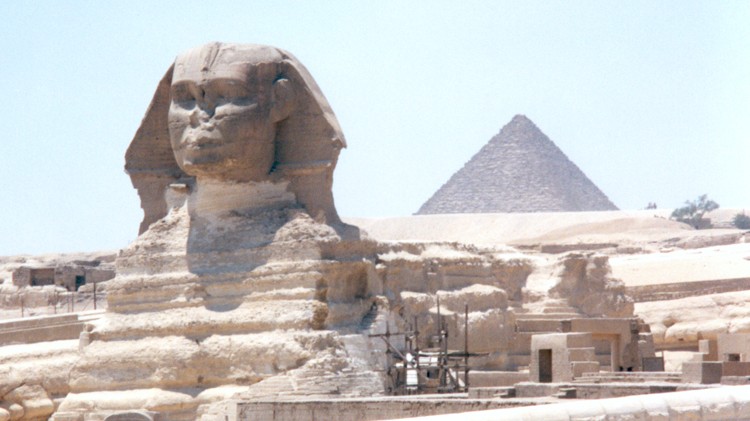
Because of the regular, predictable flooding of the Nile, life in ancient Egypt was perhaps the most pleasant of any civilization in antiquity. The gods seemed to look with favor upon the people; wars with neighboring peoples were as uncommon there as was peace in Mesopotamia or Greece. The deserts protected Egypt from invasion and lent security for the cultivation of crops, art, and technology. In the Old Kingdom (2600–2150 B.C.), Egypt’s “Classical Age,” pharoahs ruled not as priests, but as gods. There were no law codes; who needs them when the pharoah can tell you himself? The pyramids were constructed not just as tombs but as temples. The tombs of the pharoahs perpetuated the prosperity of the land. In the image above right, the Sphinx lies before the pyramid of Khafra (Chephren in Greek).
The great pyramids of Egypt demonstrate the awesome technological abilities of a civilization already accustomed to cooperative projects (such as controlling the Nile for irrigation). About 85 pyramids were built during the Old Kingdom, none with the benefit of the wheel, either in pulleys or vehicles.
Each pyramidal tomb was a magnificent signpost for robbers, proclaiming: “Treasure buried here.” Not surprisingly, all were robbed within a few centuries.
How were they constructed?
The Pyramid of Khufu (whom Herodotos called Cheops -- pronounced "Kay-opps"), was built ca. 2600 B.C. It is made of six million tons of stone precisely fitted, without mortar. The 2,300,000 limestone blocks range from 1.5 tons to 15 tons, averaging 2.5 tons each. Edwin C. Krupp calculates that its volume equals that of St Peter's cathedral in Rome, St. Paul's and Westminster Abbey in London, and the cathedrals of Milan and Florence -- combined! Its square base covers more than 13 acres. Its original height was 481.4 feet, now reduced to about 450 feet. Napoleon once sat beneath the shadow of the Great Pyramid and calculated that it contained enough stone to build a wall around France ten feet high.
The tropical sun no longer reflects off of the now-lost golden pyramidion, or capstone, which topped off the last thirty feet of the pyramid. The original dazzling white surface of tura limestone only remains near the bottom on the north side (and on the top of the Middle Pyramid of Khafra).
Otto Neugebauer has shown that orientation of the square base required no sophisticated astronomical observation, nor is there evidence that the Egyptians ever performed any. A level pyramid, large or small, may serve as a gnomon, and the shadow cast against the sun will indicate true north just as with a sundial. That is, the length of the shadow upon the ground will be shortest precisely at noon when the sun is due south; the shadow itself will point due north. For the Egyptians, the practical challenges of maintaining the orientation during construction posed a greater challenge than the mathematics of it. In practical engineering and construction they succeeded admirably: the sides of the pyramid of Khufu differ in length by less than 8 inches, and are aligned with extreme precision to the four cardinal directions, North-South-East-West, the so-called “pillars” of the sky (differing from true by at most 5.5 minutes of arc).
Why would a civilization build such wonderful structures?
The builders of the early pyramids left no explicit record of their intentions, but in the superstitious 20th and 21st centuries, even the strange power of mummifying milk has been attributed to the pyramids. Better to answer the question of their purpose by restricting ourselves to what sources of historical information are available to us: the pyramid's internal construction, and later pyramid texts.
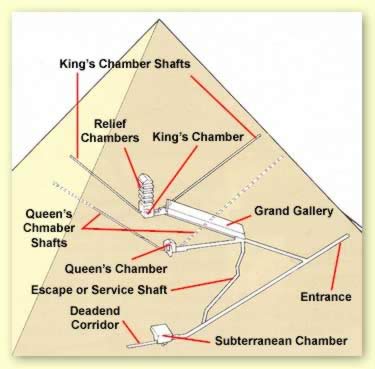 1.
The internal structure of the pyramid of Khufu
Within the pyramid of Khufu are hidden numerous corridors, chambers, and shafts.The “Descending Corridor” descends into the pyramid and the bedrock 345 feet from the entrance which opens 55 feet above ground on the north side. At a dead-end it seems to be unfinished, as if the ambitions of the builders altered the design in mid-construction.
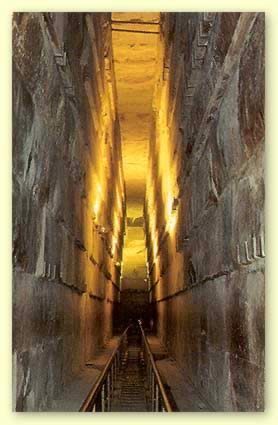 Not
far from the entrance, another corridor branches off from the Descending Corridor.
As one follows the “Ascending Corridor” upward toward the heart
of the pyramid, one enters a remarkable architectural space, the “Grand
Gallery” (pictured at left). The Grand Gallery extends 153 feet in length
along a steep climbing floor, only 7 claustrophobic feet in width, with a vaulted
ceiling disappearing into darkness 28 feet overhead.
The “King's Chamber,” at the end of the “Grand Gallery,” is completely lined with granite brought from Aswan 500 miles to the south. Only an empty, lidless sarcophagus was left for twentieth century raiders. No artifacts, no paintings, no texts survived the early plunderers. Yet the room displays symbolic elements: like the pyramid, it is oriented to the four cardinal directions. Two nine-inch square “air-shafts” run in different directions all the way to the outer surface of the pyramid.
“Grand Gallery”; “King's Chamber”; “air-shafts”; how slippery our labels can be, projecting anachronistic meanings onto unfamiliar objects which we then do not know that we do not understand. Certainly, the “air-shafts” were not there to conduct air, for the Egyptian builders were smart enough to have freshened the inside air much more effectively and efficiently if they had wanted to. Nor did the shafts make the pyramid into an astronomical “observatory,” for they bend slightly and do not follow a straight line of sight to the surface.
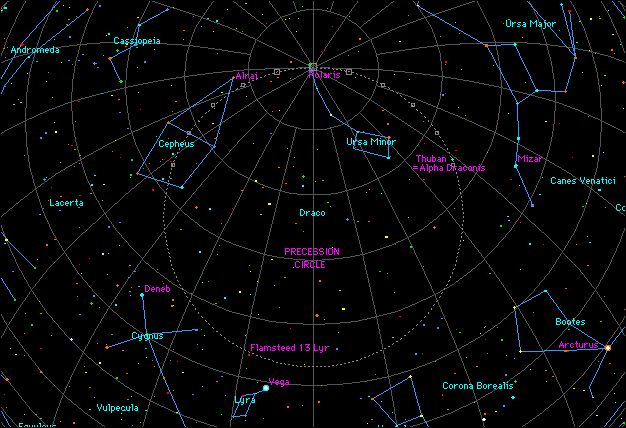
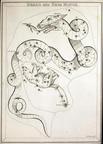 However,
astronomer Virginia Trimble showed that the northern shaft is roughly aligned
with the position then occupied by the ancient Pole Star, Thuban
(in the constellation Draco
the Dragon), at the uppermost point of its arc. (Left: Due to precession,
our north star, Polaris, did not become the most northerly star until nearly
two millenia after this time.) Similarly, the southern shaft points to the position
or declination occupied by the belt of Orion
in 2600 B.C. No other bright stars then came within three times the apparent
diameter of the Moon of this position. But within the pyramid there is no explanation
of what these “alignments” mean.
2. Pyramid Texts
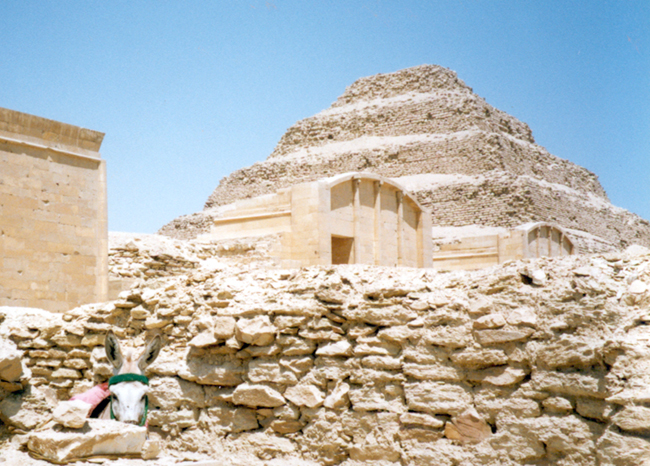 Stone-carved
prayers in later pyramid chambers of the Fifth and Sixth Dynasties (ca. 2494-2181
B.C.) found, for example, at Saqqara (left), describe the pharoah's “ascent
to the sky among the stars,” where he was to “regulate the night”
and “send the hours on the way.” Just as the pharoah had preserved
the prosperity of the land during his earth-bound life, after death he was destined
to rise overhead to preserve the order of the heavens and to take “possession
of the sky, its pillars and its stars.”
At Saqqara we find that the pharoah was to join the circumpolar stars (which neither rise nor set) and govern them, as chief among the eternal stars that never die. Might Khufu's northern shaft have pointed toward Thuban in a similar symbolic reference?
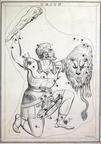 The
Pyramid Texts also describe another, previous part of the celestial journey
of the pharoah, to the constellation we call Orion
the Hunter, as it was known to the later Greeks. To the Egyptians it was called
Sahu, the abode of Osiris,
a pharoah-god who was slain by his jackal-headed brother, Set.
Osiris conquered death and, once resurrected, came to reside in Orion. The region
of Orion thus represented the cycle of life, death, and resurrection, with Osiris
presiding over the resurrection of souls.
The bright star Sothis (which we call Sirius, the brightest star in the night-time sky) lies near the region of Osiris. Sirius (Sothis) represented Isis, the wife of Osiris. The first morning rising of Sirius (after its period of invisibility) then occurred in the Spring immediately before the rising floodwaters of the Nile, on which the fertility of the soil depended. That is, Sirius rises on the eastern horizon just before the Sun once each year. This heliacal rising follows a period of complete invisibility lasting about 70 days, during which time it lies in the daytime sky. Egyptian inscriptions describe the last appearance of Sirius in the night sky as its death; its daytime invisibility as purification in the embalming house of the nether world; and its rising with the Sun into the pre-dawn sky to herald the flooding of the Nile as a resurrection. Accordingly they calibrated the process of mummification to this celestial cycle, completing it in exactly 70 days.
Here is one example of a pyramid text two or three centuries after Khufu, from the pyramid of Pepi I (ca. 2300 BC):
Utterance 442, Sarcophagus Chamber, West Wall
The king becomes a star
Truly, this Great One has fallen on his side,
He who is in Nedyt was cast down.
Your hand is grasped by Re,
Your head is raised by the Two Enneads.
Lo, he has come as Orion,
Lo, Osiris has come as Orion,
Lord of wine at the wag-feast.
"Good one," said his mother,
"Heir," said his father,
Conceived of sky, born of dusk.
Sky conceived you and Orion,
Dusk gave birth to you and Orion.
Who lives lives by the gods' command,
You shall live!
You shall rise with Orion in the eastern sky,
You shall set with Orion in the western sky,
Your third is Sothis, pure of thrones,
She is your guide on sky's good paths,
In the Field of Rushes.
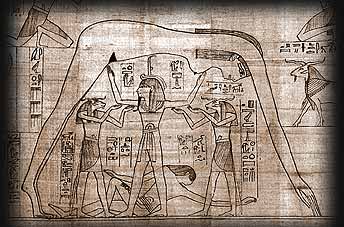 Here is another:
Utterance 446, Sarcophagus Chamber, West Wall
The sky-goddess protcets the king
O Osiris Pepi,
Nut, your mother, spreads herself above you,
She conceals you from all evil,
Nut protects you from all evil,
You, the greatest of her children!
All known Egyptian pyramids lie on the Nile's western bank, in the direction of the dying sun. Just as the sun will rise tomorrow, the pharoah himself had risen to become a star, “a living star at the head of his brethren.” The pyramid was his point of departure, the link between his earthly death and resurrection into the sky. Once in the company of Osiris, guided by Sothis, the resurrected pharoah would begin his eternal tasks of celestial administration of the kingdom of the Nile.

 .
.
| Egypt assignment index page | Intro | Pyramids | Calendar | Mathematics | Medicine |
Do you have a great quote for this page? Let me know! (If used, a new quote is worth 1 point extra credit)

|
HSCI 3013. History
of Science to 17th century |
spellcheck.net | wordcounter.net
Many thanks to the pedagogical model developed in Mythology and Folklore and other online courses by Laura Gibbs, which have been an inspiration for this course.
|
|
This course is currently undergoing major reconstruction to bring it into alignment with the new version of the course at Janux |
|||


